What is likely to happen?
Update predictions as evidence changes and keep the uncertainty visible.
Probabilistic and causal modeling
Explore what could happen, which actions could change it, and what past decisions can teach you—in one visual workspace with explicit models, assumptions, and results.
Free Spark plan. No credit card required.
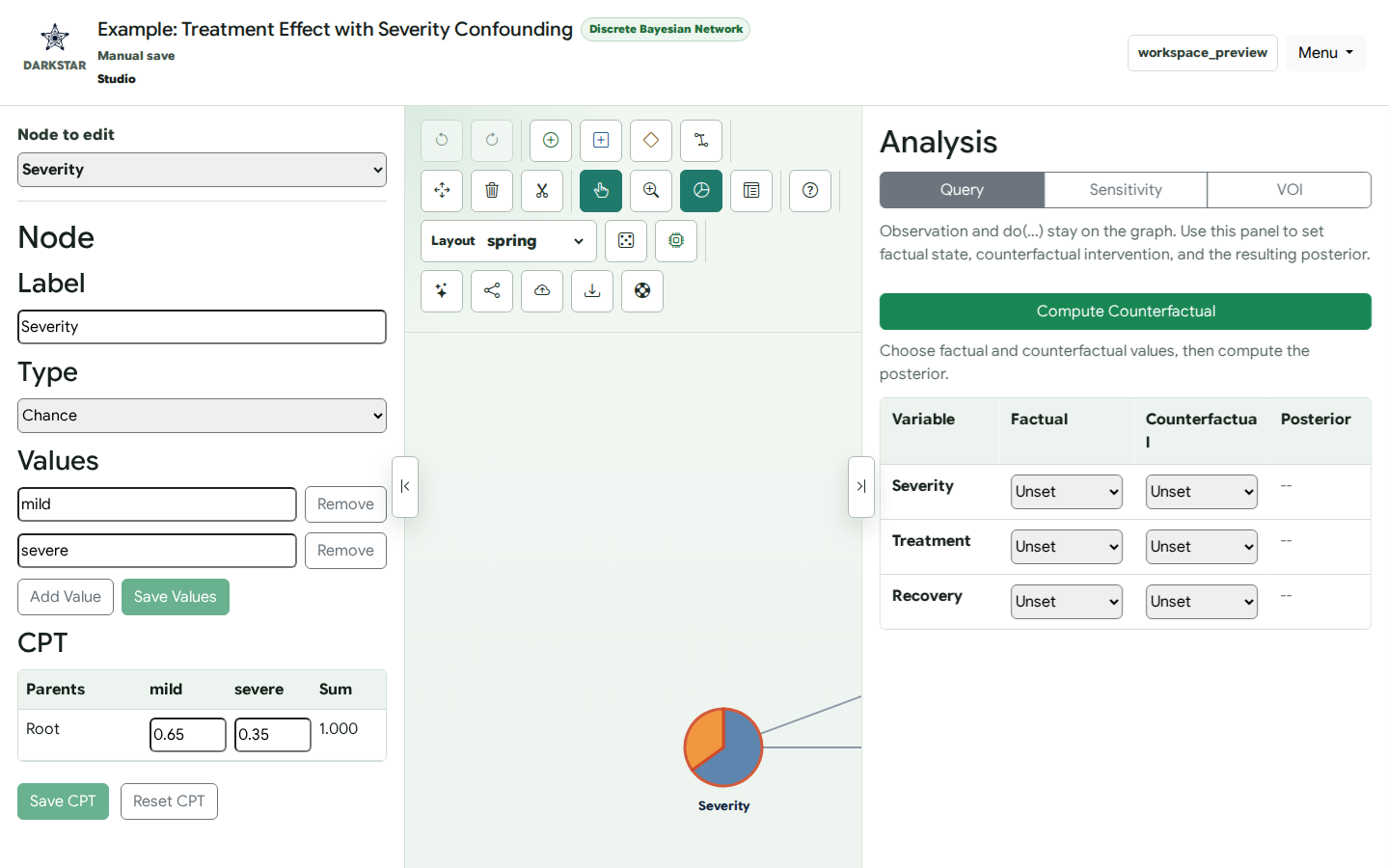
Three questions, one inspectable model
Update predictions as evidence changes and keep the uncertainty visible.
Compare supported interventions under the model’s declared causal assumptions.
Examine supported counterfactual alternatives to a factual outcome without rewriting it.
A connected modeling platform
Start from expertise or supported data workflows, ask model-appropriate questions, and carry supported results into software. Not every model supports every operation.
Build
Turn domain knowledge and supported learning workflows into explicit model structure and parameters.
Explore model familiesInfer
Use evidence updates, posterior distributions, prediction, and family-appropriate queries.
See probabilistic inferenceCompare
Apply supported interventions, effect methods, diagnostics, and counterfactual analysis.
See causal analysisIntegrate
Embed supported capabilities with SDKs or let authorized agents request explicit model operations through MCP.
Explore Agentic Causal AIWorked example
Simpson Recovery is a synthetic Bayesian-network example. Observe Treatment = treated, then set the same value as an intervention. The model stays fixed; the answer changes because Severity affects both treatment selection and recovery. This example does not demonstrate learning or a complete agent workflow.
Choose your next step
For individuals and practitioners
Open a model, edit assumptions, compare scenarios, and inspect results before deploying anything.
Start modeling freeFor organizations
Connect recurring decisions to supported models, analyses, applications, services, and agent workflows.
Explore enterprise integration